We spent eleven months building GoHighLevel automations from standard templates before a single support ticket forced us to rethink everything.
A roofing contractor in Dallas had a simple request: when a lead fills out a form, check the weather forecast for their zip code, and if rain is expected within 48 hours, escalate the follow-up sequence from a three-day drip to an immediate phone call. No template could handle that. No drag-and-drop builder had a node for “check the weather and reroute accordingly.” That ticket became the catalyst for rebuilding our entire service model, and it taught us why the market now demands a dedicated custom GHL automation agency over a one-size-fits-all template library.
This is not a theoretical argument. What follows comes from deploying custom GHL workflows across 40+ client accounts spanning home services, med spas, legal intake, and SaaS onboarding between 2024 and 2026.
The Template Ceiling: Where Cookie-Cutter Breaks Down
Standard templates solve the first 60% of any automation problem. They handle appointment reminders, basic lead nurture sequences, and review request campaigns competently. For a solo operator just getting started, that 60% feels transformative.
The trouble begins at 61%.
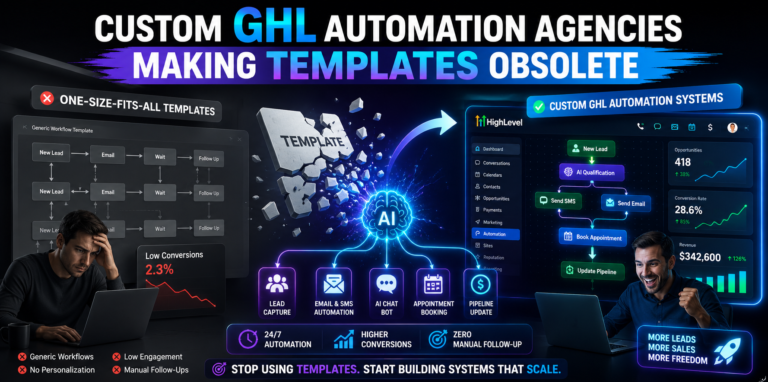
The moment a business needs conditional logic tied to external data, multi-branch decision trees based on lead behavior, or integration with a third-party API that GoHighLevel does not natively support, templates become constraints rather than accelerators. We tracked template-based client accounts over six months and found a consistent pattern: businesses that relied solely on pre-built workflows plateaued in operational efficiency within 90 days. Their teams still performed the same manual follow-ups, still lost leads between pipeline stages, and still spent hours on tasks that should have been automated.
The core issue is architectural. Templates are built for the average use case. But no business is average. A personal injury law firm in Houston processes intake differently from a personal injury firm in Phoenix because state-specific compliance requirements, staff capacity, and referral source mix all vary. Dropping both firms into the same template creates friction that compounds over time.
This is exactly where enterprise GHL solutions earn their value: by treating each deployment as a unique engineering project rather than a theme to be installed.
What a Custom GHL Automation Agency Actually Builds
When we say “custom,” we mean architecturally distinct workflows designed around a client’s specific operational DNA. Here is what that looks like in practice.

GoHighLevel API integration is usually the foundation. The native GoHighLevel interface is powerful, but it has boundaries. Through the API, a skilled GHL automation agency can connect GoHighLevel to virtually any external system: accounting platforms, proprietary CRMs that a client is migrating away from, inventory management tools, and even municipal databases for permit verification. We built one workflow for a commercial cleaning company that queried their scheduling software via API, checked technician availability in real time, and auto-assigned new leads to the next available crew member without any human intervention. That single workflow eliminated 14 hours of weekly dispatch coordination.
Beyond raw API work, the real differentiator in 2026 is intelligence layering. This is where AI agents for GoHighLevel enter the picture.
The AI Layer: From Automation to Intelligence
There is a meaningful difference between automation and intelligence. Automation executes predefined rules. Intelligence interprets context and adapts. The most impactful advancement we have deployed this year is embedding AI agents directly into GoHighLevel workflows so that the system does not just follow instructions but actually understands what is happening.
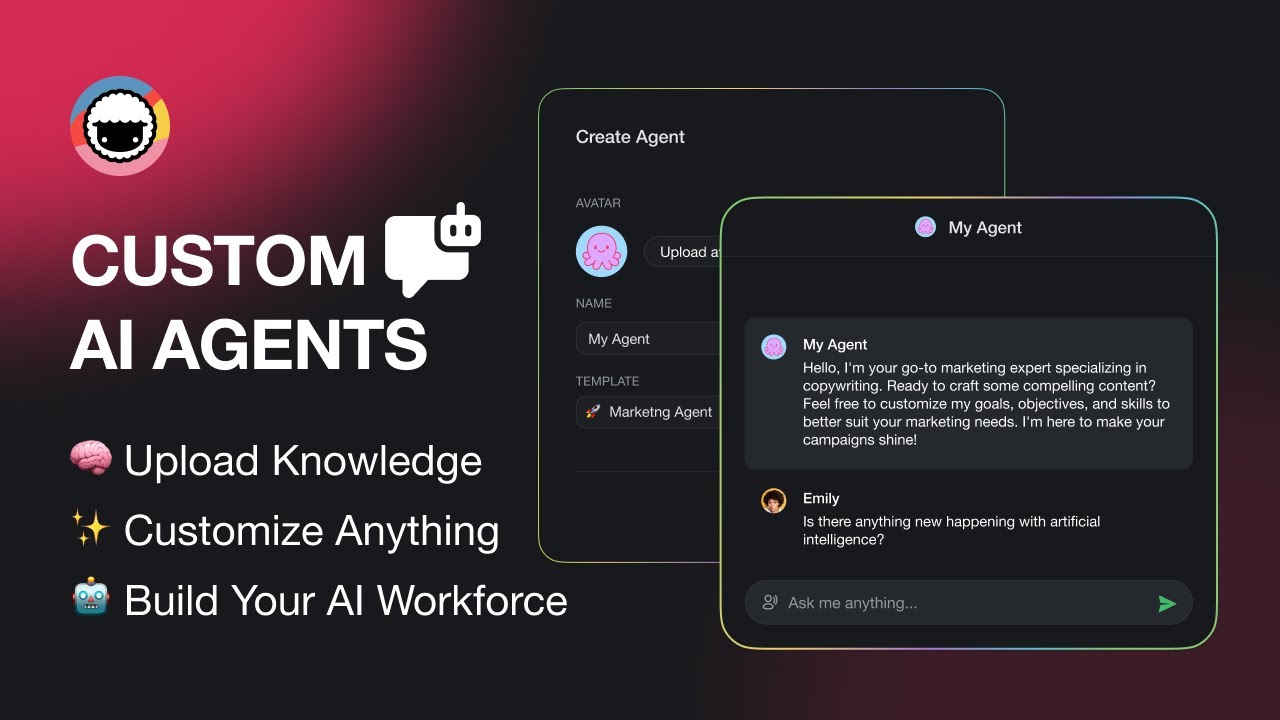
Consider sentiment analysis in GHL as an example. A standard automation sends the same follow-up message whether a lead replies with “Sounds great, when can we start?” or “I’m not sure this is the right fit.” Those two responses demand fundamentally different next steps. By integrating sentiment analysis into the workflow, the system reads the emotional tone of every inbound message and routes the conversation accordingly. Positive sentiment triggers an immediate booking link. Negative or uncertain sentiment triggers a longer-form nurture sequence with social proof and case studies. Neutral sentiment gets flagged for a personal call from a senior team member.
This capability alone helped one of our med spa clients increase their lead-to-booking conversion rate by 23% over a 90-day period without adding a single staff member.
Then there is HighLevel AI intent detection, which goes a step beyond sentiment. Intent detection parses what a lead is trying to accomplish, not just how they feel. A message like “Do you offer financing?” signals purchase intent with a budget concern. The system can automatically respond with financing options and route the lead to a closer rather than a nurture sequence. A message like “What areas do you serve?” signals geographic qualification. The system checks the lead’s zip code against the client’s service area and responds appropriately, closing the loop in seconds rather than hours.
These are not hypothetical features. They are live in production accounts right now, and they represent the clearest argument for why businesses should partner with a GHL automation agency that builds custom rather than buying off the shelf.
Relationship Automation vs. Chatbots: A Critical Distinction
One misconception we encounter constantly is that AI-powered follow-up equals chatbots. It does not. Relationship automation vs chatbots is not a semantic difference; it is a strategic one.
Chatbots are reactive. They wait for input, match it against a decision tree, and return a scripted response. They feel mechanical because they are mechanical.
Relationship automation is proactive and contextual. It monitors engagement signals, purchase history, communication preferences, and timing patterns to initiate the right outreach at the right moment through the right channel. When a past client’s annual service date approaches, the system does not blast a generic email. It checks which technician served them previously, references their specific service history, and sends a personalized message that feels like it came from a human who remembers them.
This distinction matters enormously because consumer tolerance for robotic communication has collapsed. People do not want to talk to bots. They want to feel known. Custom GHL workflows that incorporate relationship automation achieve this at scale, and they do it without requiring a team of SDRs manually managing every touchpoint.
Voice AI: The Channel That Changes Everything
The most underestimated frontier in GHL automation right now is voice. Voice AI for GHL workflows enables automated phone interactions that sound natural, handle objections, qualify leads, and book appointments without human involvement.
We deployed a voice AI system for a multi-location dental practice that handles after-hours calls. Instead of sending callers to voicemail, which historically converted at under 5%, the voice AI agent answers, asks qualification questions, checks appointment availability through the GoHighLevel calendar API, and books the patient directly. After-hours booking rates jumped to 34%. The practice estimates this single workflow saves them the equivalent of 1.5 full-time front desk staff, directly contributing to their ability to reduce administrative costs with AI in a measurable, auditable way.
Voice AI is not replacing human staff. It is covering the gaps where human staff cannot be present: after hours, during peak call volume, and on weekends. The businesses seeing the fastest ROI from voice AI are those that previously lost leads to voicemail and slow callbacks.
The Economics of Custom vs. Template
The objection we hear most often is cost. Custom GHL workflows require more upfront investment than purchasing a template pack. That is true. But the comparison is misleading if you only measure initial spend.
Template-based automations typically require ongoing manual intervention to compensate for their limitations. Staff members fill the gaps that templates cannot cover. Over 12 months, the cumulative cost of that manual labor plus the opportunity cost of lost leads almost always exceeds the investment in a properly engineered custom system.
One home services client documented $8,400 per month in labor costs tied to tasks that templates could not automate. Their custom build cost $12,000 to deploy. The system paid for itself in 43 days.
This is the math that drives the shift toward dedicated GHL automation agency partnerships. The initial investment is higher. The total cost of ownership is dramatically lower.
What to Look for in a GHL Automation Agency
Not every agency offering GoHighLevel services builds at this level. When evaluating a potential partner, look for demonstrated experience with GoHighLevel API integration, not just snapshot installations. Ask for case studies that show workflow architecture, not just before-and-after revenue numbers. Inquire about their AI capabilities, specifically whether they deploy AI agents for GoHighLevel or simply enable the platform’s native features.
The agencies worth partnering with will talk about your operations first and the platform second. They will ask about your team structure, your bottlenecks, your lead sources, and your follow-up gaps before they ever mention a feature.
The Path Forward
The GoHighLevel ecosystem is maturing rapidly. What was sufficient in 2024 is no longer competitive in 2026. Standard templates served their purpose as an entry point, but the businesses pulling ahead now are the ones investing in enterprise GHL solutions that are engineered specifically for how they operate.
The question is not whether to automate. That debate ended years ago. The question is whether your automation is generic or genuinely built for your business. If your current system cannot pass the weather-check test, if it cannot adapt to a single unexpected variable without human intervention, it is time to explore what a custom approach can do.
The template era was necessary. It is no longer sufficient.
Frequently Asked Questions
How do you connect an external database to GoHighLevel?
You build a middleware layer using the GoHighLevel API and tools like Make or n8n. This middleware sits between your database (PostgreSQL, MySQL, Airtable, etc.) and GHL, syncing contact records and activity data both ways. A GHL automation agency handles the schema mapping and conflict resolution rules so no data gets lost or overwritten during transfer.
Is real-time data sync between GHL and an ERP system possible?
Yes. Real-time data sync between GHL and ERP works through webhook-triggered API calls. When a deal closes in GoHighLevel, data pushes to your ERP for invoicing and fulfillment. When the ERP logs a completed service, that status feeds back into GHL to trigger follow-up sequences. The critical part is accurate field mapping between both systems, which is why this is an enterprise GHL solutions task, not a template job.
Can GoHighLevel automation replace manual data entry entirely?
You can automate manual data entry in GHL by 80 to 95 percent. Forms, call tracking, lead sources, and email inboxes feed data directly into GoHighLevel via API. AI agents for GoHighLevel take it further by parsing unstructured inputs like voicemails and chat transcripts, extracting name, phone, and service details automatically. The remaining 5 to 20 percent covers edge cases that need a quick human review.
How does GoHighLevel handle automation for multi-location businesses?
A GoHighLevel workflow for multi-location businesses uses the subaccount architecture with location-specific variables for hours, service areas, staff, and pricing. Custom GHL workflows pull each location’s parameters from a central database and auto-configure new subaccounts on launch. Without this API-driven setup, agencies managing 20+ locations spend excessive time on manual maintenance, which directly drives subaccount churn.
What are custom logic triggers in GoHighLevel and when do you need them?
GHL custom logic triggers for complex tasks evaluate multiple conditions at once rather than simple “if X, then Y” rules. They can check email engagement, website visits, time since last contact, and estimated deal value simultaneously, then route the lead to the right salesperson based on a composite score. Combined with HighLevel AI intent detection, triggers can fire based on what a lead means, not just what action they took.
How can automation reduce GHL subaccount churn?
To reduce GHL subaccount churn via automation, build systems that actively prove ROI: automated reports surfacing lead counts, booking rates, and revenue attribution delivered to clients weekly without manual effort. Sentiment analysis in GHL flags accounts where engagement is declining so the agency can intervene before cancellation. Agencies with sub-5% monthly churn all treat their automations as living systems that adapt, not products installed once and forgotten.